
The board rejected the government's plea to extend his detention for another 3 months.

Pakistan-based Lashkar-e-Tayiba's technology chief had posed as an Indian businessman while negotiating to buy from an American company a Voice-over-Internet Phone service that was later used by the LeT handlers to communicate with 26/11 attackers while concealing their actual origin.
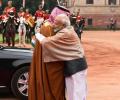
'The most unfortunate part is that after precipitating the crisis situation on Tuesday, the government ducked and took help from Saudi Arabia and the UAE to 'de-escalate' the situation.' 'Make no mistake, this fateful move has grave implications.' 'You don't take help from the wolf to guard the sheep, right?' says Ambassador M K Bhadrakumar.

Rana knew about my association with LeT. I informed him about the training imparted by me to LeT operatives. I disclosed to Rana that I was spying for LeT. This was four to five months before the 26/11 attacks," said Headley.
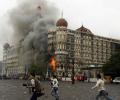
Pakistani-American terrorist David Coleman Headley on Thursday exposed how Inter-Services Intelligence and Lashkar-e-Tayiba majorly funded terror operations in India.

Mumbai police, citing his suicide note, said the 1988-batch Indian Police Service officer took the extreme step 'out of frustration' due to his illness.

What distinguishes 26/11 from other bombings in big cities, for instance 9/11 in New York or 7/7 in London, is that it remains the best-documented attack in a digitally enhanced world, says Sunil Sethi

He also said it was for India to decide on dates for Foreign Secretary-level talks, postponed in the wake of the terror strike.

Here is how Headley became an 'international' terrorist from being a nondescript

Pakistan's hawkish Army chief Gen Ashfaq Parvez Kayani, who did little to change the force's India-centric stance, will leave the world's sixth-largest army grappling with a host of security challenges when he steps down on Friday.
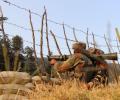
'India has to understand that the permanent state of war that exists between India and Pakistan has to be expected,,' says Colonel Anil A Athale (retd). 'The only way to ensure peace or absence of war is to maintain a militarily-dominant position over Pakistan.'
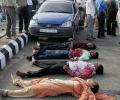
The family and the lawyer of Ishrat Jahan, who was killed in an alleged fake encounter in Gujarat, on Thursday raised questions over David Coleman Headley's testimony that she was a Lashkar-e-Tayiba operative, saying this was for the "political benefit of some big people" whose names have been "besmirched."
akistani-American David Coleman Headley outline how the Lashkar-e-Tayiba and the Inter-Services Intelligence wanted to spread terror in India.

Deposing for the third day after his cross-examination began on Wednesday, Headley said Yousuf Raza Gilani, former Pak PM, had visited his house after the 26/11 attacks.

'There is a consensus within the Indian security establishment -- at least among those who draw their conclusions from data instead of speaking from nationalist sentiment -- that India lacks the offensive capability to defeat Pakistan in a short war.'
'The talks held in Bangkok, virtually on Indian terms, is an event where Pakistan seems to have blinked first.'

A senior former Obama administration official said if another attack would have happened like that, it would 'quickly escalates into a regional war'.
'The Modi government would chaff at the very idea of holding talks with Pakistan, facilitated by Washington and under close US monitoring, when the 2019 poll is sailing into view.' 'But in politics and diplomacy, there may be moments when drinking from the chalice of poison is necessary,' says Ambassador M K Bhadrakumar.
A realistic assessment will tell us that not much has changed between India and Pakistan; the relationship remains as fraught as before with little prospect of reconciliation, notes Ajai Shukla.

'His secretary of defence nominee, General James Mattis, says he expects Pakistan to take action against terrorists operating from its soil.' 'Any pressure the US can bring on the Pakistani regime terror-wise would pay dividends for India.'
If viewed as a part of the Al Qaeda's radicalisation effort to produce jihadists out of discontented Muslim youth in India, the call could well have a much larger dimension, both in the near as well as long term, directly impacting on national security, says Bibhu Prasad Routray.
Jamaat-ud-Dawah chief Hafiz Saeed's detention may help ease India-Pakistan tension, media reports in Islamabad said on Tuesday even as supporters of the Mumbai attack mastermind launched protests across major cities against the government's decision which they say was taken under pressure from the US and India.

The question really is whether the US can be persuaded to embark on a path of calibrated and stronger sanctions on Pakistan.

'Washington is telegraphing here is its willingness to support a low-grade, limited use of force meant to send a strong message to Pakistan.' 'Perhaps something along the lines of the surgical strikes in 2016, or perhaps something a bit more -- but not much more.'
Nawaz Sharif may have permitted the trial of Jaish-e-Mohammed terrorists for the Pathankot attack. But this fell apart because of General Raheel Shareef's keenness to make Kulbhushan Jadhav the centerpiece of global attention. Ambassador G Parthasarthy, a former Indian high commissioner to Pakistan, reveals the Pakistan army chief's gambit against India.

Immediately after India launched its surgical strikes, sources said, it had informed the US of its action.

Former chief of R&AW C D Sahay dismisses comments linking the Gujarat riots and Babri Masjid demolition to the formation of the Indian Mujahideen

The Lashkar-e-Tayiba operative also revealed about his training while he deposed in front of a Mumbai court via video link.

'If the bulk of the Pakistan population and the all powerful army are now against radical elements, there is indeed hope that Pakistan's India policy will be more realistic and less ideology driven,' says Colonel Anil A Athale (retd).

'The clique that runs that country is treating us like suckers. We are very foolish, giving people money who involve themselves in activity that's harmful to America.' 'When you look at the cold hard facts, Pakistan is not an ally to the United States. They have facilitated, they have encouraged, they have been a protector of enemies.'
'The interests of the United States and India are sharply aligned on the issue of Pakistan-based terrorism.'

Even as France mourns the bloodiest terrorist attack for 20 years, let's take a look at some major standoffs witnessed in the past:

Experts trace the reasons for the 26/11 attacks to the Pakistan's military interest in three key areas: Kashmir, Afghanistan and nuclear armaments.

'The Senators were playing safe, not angering either the pro-India lobby or the pro-Pakistan lobby, but perhaps more importantly, the military-industrial complex -- the most powerful lobby of all -- which the majority of Senators are beholden to in terms of largesse to their campaign coffers.'

'At this point, neither the army or the IAF has that immediate, punitive deterrent power against Pakistan.' 'Forget a three-week war; on the LoC, where the action is, Pakistan has until now fielded better infantry weapons, body armour, sniper rifles, and matching artillery' points out Shekhar Gupta.
To a question, Headley further clarified that he had informed the NIA that 'this woman (Jahan) was an Indian and an LeT operative' but could not explain why this was not recorded in his statement.

'Diplomatic engagement will continue even as India keeps all its options open with respect to discretely targeting the Pakistani military and its terrorist proxies.'

It would be foolish for Pakistan to assume that India would not act no matter what the provocation is, just because it is militarily more powerful than Myanmar and is armed with nuclear weapons, says Anand Kumar.
A Mumbai court on Thursday pardoned Pakistani-American Lashkar-e-Tayiba operative David Headley, who had surveyed targets for the 26/11 attacks, and made him an approver in the case, a move that may unravel the conspiracy behind the brazen terror assault.
In related findings for India, the FATF in a report brought out last month, chronicled the use of banking channels to fund the activities of the banned terror group Hizb-ul-Mujahideen.
 © 2026 Rediff.com - Advertise with us - Disclaimer - Privacy Policy - Sitemap - Feedback - About us - Terms of use - Grievances